Teacher-ready lesson library

Paper Fortune Teller Classroom Activities

Structured 10-to-20 minute lesson plans for Math, Reading, Language, SEL, and Science review. Each activity features an 8-prompt curriculum set, teacher demonstration, student procedures, exit ticket, and 1-click loading into the printable maker.

Curriculum Review: September 2026. Original adaptable examples; source context below.
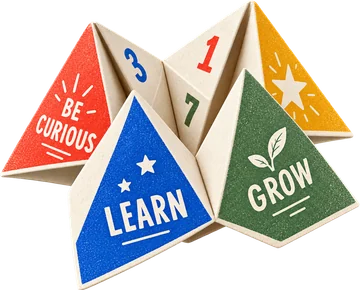
Folded schoolhouse paper fortune teller on cutting mat
Classroom-ready origami quiz game with prompt and answer flaps.

Find an Activity

Showing 6 matching activities.

Grades 3–5 Math Facts 15 Minutes Pair Work

Multiplication Sprint & Fact Families

Learning Objective

Students rapidly recall core multiplication facts (factors 3 through 9) and verbally state the inverse division fact within 5 seconds.

Preparation & Materials

One printed fortune teller per pair, scissors, pencils, and one scrap paper or whiteboard per student for fact family recording.

8 Prompt & Answer Pairs (Outer question -> Hidden solution)

1
6 × 7 = ?42 (Fact family: 42 ÷ 6 = 7)
2
8 × 4 = ?32 (Fact family: 32 ÷ 8 = 4)
3
9 × 3 = ?27 (Fact family: 27 ÷ 9 = 3)
4
7 × 8 = ?56 (Fact family: 56 ÷ 7 = 8)
5
6 × 9 = ?54 (Fact family: 54 ÷ 6 = 9)
6
4 × 9 = ?36 (Fact family: 36 ÷ 4 = 9)
7
8 × 8 = ?64 (Fact family: 64 ÷ 8 = 8)
8
7 × 7 = ?49 (Fact family: 49 ÷ 7 = 7)

Teacher Demonstration

Model the activity under a document camera with a student partner:

  1. Partner A holds the fortune teller, invites Partner B to pick a color, spells it, and opens the flaps.
  2. Partner B selects a number; Partner A counts it out and reads the multiplication prompt.
  3. Partner B gives the answer; Partner A lifts the flap to confirm the product and inverse fact.
  4. Swap roles after three rounds.

Student Procedure

  1. Sit knee-to-knee with your designated partner.
  2. Partner A operates the teller through the color spell and number count.
  3. Partner B states both the product and the matching division equation within 5 seconds.
  4. Partner A lifts the flap to verify. If correct, mark a point. If incorrect, partner coaches using an array model.
  5. Switch roles after each question. Complete 8 rounds total.

Answer Check & Exit Ticket

Fast 3-Fact Slip: Before concluding the lesson, each student writes any three multiplication equations they practiced today alongside their inverse division equations on an exit slip.

Differentiation & Adaptation

  • Support: Provide a laminated 10×10 multiplication chart or array blocks for physical verification.
  • Challenge: Require students to create a real-world word problem matching the product before lifting the flap.
View folding instructions →
Grades 3–5 Reading Comprehension 20 Minutes Small Group (3–4)

Story Elements & Text Evidence Detective

Learning Objective

Students analyze characters, setting, plot conflict, and central theme in their current class text by providing direct supporting text evidence.

Preparation & Materials

One printed fortune teller per literature circle group, current classroom reading novel or short story, sticky notes, and pencils.

8 Prompt & Answer Pairs (Outer question -> Hidden criteria)

1
Who is the protagonist?Main character: describe one major trait with text evidence
2
Describe the settingTime & place: find two descriptive details in the text
3
What is the main conflict?Internal or external struggle driving the plot
4
Name an antagonist forcePerson, nature, or society opposing the main character
5
Find a turning pointClimax: the moment the character makes a big choice
6
Identify a story symbolObject or motif representing a larger thematic idea
7
State the central themeThe author's message or life lesson learned
8
Predict the resolutionHow the conflict will resolve based on clues

Teacher Demonstration

Model using an anchor chapter text familiar to the entire class:

  1. Select prompt 3 ("What is the main conflict?").
  2. Demonstrate opening the book to cite a specific paragraph and page number rather than summarizing from memory.
  3. Show how the answer flap sets the standard for textual rigor.

Student Procedure

  1. Form groups of 3–4 with copies of the shared reading text open.
  2. Student 1 operates the fortune teller; Student 2 picks a color and number.
  3. Student 2 reads the prompt and has 60 seconds to locate one sentence of evidence in the book.
  4. Remaining group members verify the quote. If validated, pass the teller clockwise.

Answer Check & Exit Ticket

Evidence Sticky Note: Each student places a sticky note on their desk with their chosen prompt, the story element, and the exact page citation discovered during the session.

Differentiation & Adaptation

  • Support: Pre-mark candidate paragraphs with colored tabs or pair students with a reading buddy.
  • Challenge: Ask students to explain how changing the setting would alter the nature of the primary conflict.
View folding instructions →
Grades 1–2 Language & Grammar 10 Minutes Pair Work

Parts of Speech Quick Workout

Learning Objective

Students identify, categorize, and produce nouns (person, place, thing), action verbs, and descriptive adjectives in spoken sentences.

Preparation & Materials

One printed fortune teller per pair, personal whiteboards or lined paper for recording sample words.

8 Prompt & Answer Pairs (Outer challenge -> Hidden examples)

1
Name 3 action verbsWords that show action: run, jump, whisper, build
2
Name 3 person nounsPeople: teacher, doctor, friend, astronaut
3
Name 3 place nounsPlaces: library, forest, playground, kitchen
4
Name 3 thing nounsThings: pencil, telescope, backpack, guitar
5
Name 3 color adjectivesDescribing words: crimson, golden, emerald, azure
6
Name 3 size adjectivesDescribing words: gigantic, tiny, microscopic, vast
7
Name 2 feelings wordsAdjectives for emotions: joyful, nervous, brave, curious
8
Make a 4-word sentenceSentence with noun, verb, and adjective (e.g. The swift dog ran)

Teacher Demonstration

Engage in a quick whole-class choral drill:

  1. Call out "Noun!" and tap your desk; call out "Verb!" and jump up.
  2. Show the fortune teller under the document camera, land on prompt 1 ("Name 3 action verbs"), and have students whisper three verbs to their elbow partner.

Student Procedure

  1. Partner A operates the teller through the color and number count.
  2. Partner B speaks three valid words fitting the prompt within 10 seconds.
  3. Partner A lifts the flap to check the grammar rules and example words.
  4. Partner B writes one favorite word on their mini whiteboard.
  5. Swap roles and repeat for 6–8 rounds.

Answer Check & Exit Ticket

Whiteboard Flash: On teacher cue, every student holds up their whiteboard displaying one noun, one verb, and one adjective created during the game.

Differentiation & Adaptation

  • Support: Reference a color-coded classroom word wall (blue = nouns, red = verbs, green = adjectives).
  • Challenge: Require students to use their three words in a single grammatically correct complex sentence.
View folding instructions →
Grades 1–2 / Early Elem SEL & Community 10 Minutes Individual / Advisory

Morning Emotion Check-in & Mindful Reset

Learning Objective

Students identify their emotional readiness to learn, practice an evidence-based self-regulation breath or stretch, and express positive classroom community mindset.

Preparation & Materials

One printed fortune teller per student desk or calming corner station, calm instrumental transition music.

8 Prompt & Answer Pairs (Check-in prompt -> Mindful strategy)

1
Energy check today?Low, steady, or high energy: both are normal and welcome
2
Take 3 deep breathsInhale through nose 4 sec, hold 2 sec, exhale slowly 6 sec
3
Name 1 thing you enjoyA pet, game, book, or snack that brought a smile today
4
One goal for this morning?Focus on math, help a classmate, or ask one question
5
Who can help you today?Teacher, counselor, seat partner, or playground buddy
6
Do a 5-second stretchRoll shoulders back, stretch arms upward, relax jaw
7
Give a silent cheerSend positive silent energy or a thumbs-up to a neighbor
8
One kind word for yourself'I am learning, I am patient, and I will try my best'

Teacher Demonstration

Lead a whole-class mindful modeling moment:

  1. Model prompt 2 ("Take 3 deep breaths") with hand on heart and stomach.
  2. Reiterate classroom psychological safety: every emotion is acknowledged without judgment.

Student Procedure

  1. During morning arrival or after recess transition, pick up your personal check-in teller.
  2. Operate the teller independently or with a table partner.
  3. Reflect on the prompt silently for 30 seconds and complete the reset action.
  4. Place the teller in your desk pocket as a calming tool for later in the day.

Answer Check & Exit Ticket

Thumb Thermometer: As the teacher calls attendance, students give a discreet thumb signal (up = ready to learn, sideways = okay, down = would appreciate a 1-minute check-in).

Differentiation & Adaptation

  • Support: Allow non-verbal students to point to an emotion emoji anchor card.
  • Challenge: Encourage students to write a short 2-sentence journal entry describing which reset strategy helped most.
View folding instructions →
Grades 6–8 Science Review 15 Minutes Pair Work

Earth's Water Cycle & Weather Systems

Learning Objective

Students explain evaporation, condensation, precipitation, transpiration, and surface runoff within Earth's hydrosphere driven by solar energy and gravity.

Preparation & Materials

One printed fortune teller per lab pair, science notebooks, and diagram reference sheets.

8 Prompt & Answer Pairs (Scientific term -> Conceptual definition)

1
Define evaporationLiquid water gains thermal energy and changes into water vapor
2
Define condensationWater vapor cools and condenses into liquid cloud droplets
3
What is precipitation?Water falling to Earth as rain, snow, sleet, or hail
4
Explain transpirationPlants release water vapor through stomata in their leaves
5
Describe surface runoffWater flowing over land into streams, rivers, and oceans
6
What causes wind?Unequal heating of Earth creating atmospheric pressure shifts
7
Define groundwaterWater absorbed into soil and stored in underground aquifers
8
Sun's role in the cycle?Main energy engine driving phase changes and weather systems

Teacher Demonstration

Model academic precision under the document camera:

  1. Select prompt 1 ("Define evaporation").
  2. Model full molecular terminology: thermal energy increases kinetic energy, causing phase change from liquid to gas.
  3. Show how the flap answers provide rigorous self-checking standards.

Student Procedure

  1. Lab partners sit together with science notebooks closed.
  2. Partner A operates the teller; Partner B answers using at least two key scientific vocabulary terms.
  3. Partner A lifts the flap to confirm and clarify misconceptions.
  4. Swap roles every question for a total of 8 rounds.

Answer Check & Exit Ticket

Cycle Flow Chart: Students complete an unlabelled 5-step diagram showing the movement of a water molecule from ocean to cloud to river.

Differentiation & Adaptation

  • Support: Provide a root-word glossary (e.g. trans- = across, condensare = to make dense).
  • Challenge: Ask students to hypothesize how deforestation impacts regional transpiration and precipitation rates.
View folding instructions →
Grades 6–8 Science Review 20 Minutes Small Group (3–4)

Food Webs & Energy Flow in Ecosystems

Learning Objective

Students trace energy transfer across trophic levels from primary producers through consumers, describe decomposer cycling, and apply the 10% energy rule.

Preparation & Materials

One printed fortune teller per group of 3, ecosystem diagram cards, and dry-erase markers.

8 Prompt & Answer Pairs (Ecology concept -> Trophic principle)

1
What is a producer?Autotroph making own food via photosynthesis (e.g. plants, algae)
2
Define primary consumerHerbivore feeding directly on producers for energy
3
Define secondary consumerCarnivore or omnivore eating primary consumers
4
Role of decomposers?Fungi and bacteria recycling dead organic matter into nutrients
5
Where do arrows point?Arrows point in direction of energy flow (food to consumer)
6
What is the 10% rule?Only ~10% of energy transfers to the next trophic level
7
Define apex predatorTop predator with no natural enemies in its ecosystem
8
Impact of removing species?Trophic cascade disrupting population balances across the web

Teacher Demonstration

Illustrate arrow orientation on the whiteboard:

  1. Draw grass → grasshopper → frog → hawk.
  2. Emphasize that the arrow represents calories and biomass transferring into the consumer.

Student Procedure

  1. Groups of 3 assign roles: Operator, Responder, and Energy Recorder.
  2. Responder answers the ecological prompt; Recorder tallies energy points on a group whiteboard.
  3. Operator lifts flap to verify definition and energy rule.
  4. Rotate roles every two questions.

Answer Check & Exit Ticket

Energy Pyramid Check: Draw a 3-tier trophic pyramid with a 10,000 kcal producer base; calculate the energy available to the top tier.

Differentiation & Adaptation

  • Support: Provide pictorial organism cards to arrange into physical chains before folding.
  • Challenge: Analyze real-world bioaccumulation of microplastics across trophic levels.
View folding instructions →
Instructional references

Instructional Models & Educational References

The practice of using folded paper fortune tellers (cootie catchers) as hands-on learning manipulatives is documented in published academic and public agency educational programs:

  • University of Pennsylvania Community-Based Mathematics Project (CBMP): Fortune Tellers: Shapes and Area lesson plan exploring area, unit fractions, rectangles, squares, and right triangles through folding a paper fortune teller. Reference: UPenn CBMP Lesson Plan: Fortune Tellers: Shapes and Area.
  • California Department of Public Health (CDPH): Youth education instructor guide utilizing the interactive cootie catcher format for peer discussion prompts, interactive review questions, and guided health curriculum engagement. Reference: CDPH Instructor Guide (PDF).
Curriculum Notice: The six activity cards provided on this page are original, teacher-adaptable sample activities created for this website. They are not official curriculum materials of, nor are they endorsed or sponsored by, the University of Pennsylvania, the California Department of Public Health, or any educational standards organization. We make no official standards-alignment claims; educators should adjust prompt sets to fit their own district guidelines and learning goals.
Frequently asked questions

Classroom Activities FAQ

How do paper fortune tellers support classroom learning?

Folded paper manipulatives combine tactile fine-motor activity with active retrieval practice. The step-by-step game mechanics (spell, count, select, reveal) create a low-stakes, self-checking peer review structure that boosts student engagement.

Can I edit these classroom activity questions before printing?

Yes. Clicking "Load into printable maker" sends all eight prompt/answer pairs into our online editor, where you can modify wording, add student names, choose your paper size, and print custom copies.

How long does it take for students to fold the paper?

Elementary students typically take 4 to 6 minutes to fold their first fortune teller with teacher modeling. Once folded, each activity card provides 10 to 20 minutes of repeatable curriculum practice. See our folding guide for a step-by-step demonstration.

Are these activities aligned with specific educational standards?

The six lesson cards are original, adaptable examples created for flexible classroom practice—they are not formal standards-alignment claims and carry no endorsement from standards bodies. They draw on published tactile manipulative models (such as UPenn CBMP math folding lessons and CDPH health education guides), and educators can easily edit and customize all prompt sets using the maker to match local district goals.

What supplies do students need for these lessons?

Each student or pair needs one printed sheet (US Letter or A4), scissors to cut the outer perimeter square, and a pencil or whiteboard for recording exit tickets. No glue, tape, or special craft supplies are required.